
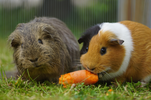
Small, Squeaky and Full of Opinions: Understanding Guinea Pigs
, by Majella Gee, 109 min reading time
, by Majella Gee, 109 min reading time
Guinea pigs may be small, but there’s far more to caring for them than a hutch, a bowl of food and the occasional cuddle. From companionship and housing to diet, vitamin C, teeth, handling, enrichment and those unmistakable wheeks, discover what these funny, social little animals really need for a happy, healthy life.
There are few animals quite as capable of making their feelings known as a guinea pig.
Open the fridge. Rustle a bag. Chop a capsicum. Walk anywhere remotely near the place where the food is kept and suddenly:
Wheek! Wheek! WHEEEEK!
For such a small animal, a guinea pig can have some remarkably strong opinions—particularly about dinner.
But that's part of their charm. Guinea pigs, or cavies, are funny, social and surprisingly expressive little animals. They learn routines, recognise the people who care for them and communicate through an extraordinary collection of squeaks, whistles, rumbles, purrs and chatters. And then there's popcorning—those wonderful little jumps, twists and bursts of excitement that can make a happy guinea pig look as though someone has suddenly pressed the eject button.
Spend enough time with guinea pigs and you quickly discover that they aren't simply little furry animals sitting quietly in a hutch waiting to be cuddled. They have preferences. They form relationships. They explore, forage, hide, play and learn remarkably quickly which human controls access to the vegetables.
Unfortunately, their small size has also worked against them.
For generations, guinea pigs have been sold as an easy first pet for children: a small hutch, a bowl of dry food, some lettuce and water, and perhaps a cuddle every now and then.
But guinea pigs aren't particularly simple pets at all.
They have very specific nutritional requirements. Their teeth never stop growing. Their digestive system depends on a constant supply of fibre. They cannot manufacture their own vitamin C. They need companionship, space, shelter, enrichment and careful handling. And because they're prey animals, they can be very good at hiding the early signs that something is wrong.
So if you're thinking about welcoming guinea pigs into your family—or you've already got a couple of little wheeking residents in the backyard—there's quite a lot worth knowing.
And we might need to rethink a few of the things we've been doing for years.

Small Pet Doesn't Mean Simple Pet
One of the biggest misconceptions surrounding guinea pigs is that they're an ideal “starter pet.”
I don't particularly like that expression.
No animal should really be a practice run for another animal, and being smaller doesn't automatically make an animal easier to care for. In some respects, the opposite can be true.
A dog that misses one meal will usually be fine. A guinea pig that stops eating can become seriously ill surprisingly quickly. Their continuously growing teeth depend heavily on the right diet and chewing behaviour. Their requirement for dietary vitamin C means we need to pay attention to what we're feeding them rather than simply filling a bowl with generic small-animal mix.
They're also more fragile than they look.
That doesn't mean guinea pigs can't be wonderful family pets. They absolutely can. Their generally gentle nature, entertaining personalities and ability to form strong bonds can make them delightful companions.
But the adult in the household needs to accept responsibility for their care.
A child can help prepare vegetables, refill hay, clean an enclosure and gradually learn how to interact with guinea pigs safely. That's a wonderful way to teach kindness and responsibility. But an animal's welfare shouldn't depend entirely on whether a child remembers to feed it before school or gets bored with cleaning the enclosure six months later.
And buying a guinea pig for a child doesn't necessarily mean that child is ready to pick it up and carry it around.
We'll come back to handling later, because it's something I feel particularly strongly about after an incident I witnessed many years ago in one of my pet stores.
For now, the important thing to remember is this:
Guinea pigs may come in a small package, but their needs aren't small.
And one of the most important of those needs is something humans sometimes forget altogether.
Your Guinea Pig Probably Wants a Guinea Pig
We might love our guinea pigs dearly, talk to them, cuddle them and arrive bearing capsicum like some sort of vegetable-delivery service, but we're still not guinea pigs.
Guinea pigs are naturally social animals. They communicate with one another, rest near one another, forage together and develop relationships within their group. Human company is valuable, but it doesn't completely replace the companionship of their own kind.
For that reason, guinea pigs are generally better kept with a compatible guinea-pig companion rather than living alone.
That doesn't mean putting any two guinea pigs together and assuming they'll become best friends. Sex, temperament, age, available space and the way introductions are handled can all affect whether a pairing works. They also need enough room, hiding places and access to resources so one animal can't constantly control the food, water or best sleeping spot.
And make absolutely certain you know the sex of your guinea pigs. An undesexed male and female can very quickly turn two guinea pigs into considerably more than two. If you're unsure, have them properly sexed by an experienced veterinarian rather than relying on guesswork. If you're considering a mixed-sex pair, talk to your vet about the appropriate desexing options first.
And despite an old tradition of housing guinea pigs with rabbits, a rabbit isn't a substitute for another guinea pig. They communicate differently, have different nutritional requirements, and a rabbit can seriously injure a guinea pig—even without intending to—simply because of the difference in their size and strength.
Give a guinea pig another compatible guinea pig, however, and you get to see a whole range of behaviour that we can easily miss when they're kept alone.
They'll chatter, follow one another, forage, squabble occasionally, settle together and seemingly discuss important guinea-pig matters that we're not invited to understand.
Probably vegetables.
It's usually vegetables.

Where Should Guinea Pigs Live?
Ask ten guinea-pig owners what the perfect setup looks like and you'll probably get ten different answers.
Some guinea pigs live entirely indoors. Others have large outdoor enclosures. Many Australian families use a combination of a sheltered hutch and a movable run that allows their guinea pigs to spend time grazing on fresh grass.
Any of these arrangements can work well. What matters isn't whether the enclosure is labelled indoor or outdoor. What matters is whether it gives the guinea pigs enough room to move around, somewhere secure to rest and hide, protection from predators and weather, and an environment that doesn't become dangerously hot.
A Hutch Shouldn't Be Their Entire World
The traditional guinea-pig hutch is often much too small to provide everything these active little animals need.
Guinea pigs need room to walk, run, explore, forage and occasionally perform one of those gloriously ridiculous popcorns. They also need several places to hide. Remember, these are prey animals. Being able to retreat somewhere when they feel threatened isn't a luxury; it's an important part of feeling secure.
If you're keeping more than one guinea pig—and ideally you are—space becomes even more important. Each animal should be able to move away from the other when it wants to. Food, water and hiding areas shouldn't be arranged so that one bossy guinea pig can control everything.
And don't be fooled by their size. A guinea pig might fit comfortably in your hands, but that doesn't mean its entire life should fit inside a tiny cage.
For a pair of guinea pigs, I'd be looking at an enclosure of at least 2 metres by 0.5 metres, and I'd always prefer to give them more room where possible. Don't treat those measurements as a target to squeeze them into. If you can safely provide more space to run, forage, explore and get away from one another when they want to, even better.
Indoor Guinea Pigs
Keeping guinea pigs indoors can make it easier to protect them from extreme temperatures, predators and sudden weather changes. It can also mean they become more involved in everyday family life.
But indoor guinea pigs still need a substantial enclosure, exercise and enrichment. A small cage sitting in the corner of a room isn't enough simply because it's inside.
Think about where you position them too. An enclosure beside a sunny window can become surprisingly hot, while air conditioners and draughts can create another set of problems.
They also need somewhere peaceful to retreat from dogs, cats, excited children and the general chaos of family life.
If your guinea pigs are allowed floor time outside their enclosure, make sure the area is guinea-pig-proofed first. Electrical cords are particularly important because guinea pigs are enthusiastic chewers, but also check for toxic houseplants, soft plastics, small gaps they could disappear into and anything else within reach that could be chewed or swallowed.
And while you may enjoy having the television turned up or the vacuum cleaning roaring around the room, your guinea pigs didn't necessarily vote for either.

Outdoor Guinea Pigs: Particularly in Australia
This is where I think we need to pay special attention.
In Australia, keeping guinea pigs outdoors is common. A good outdoor setup can give them wonderful opportunities to experience fresh air, natural light, different smells and sounds, and—when it's safe—fresh grass beneath their feet.
But our climate can also make outdoor housing dangerous.
Guinea pigs cope poorly with heat. They don't sweat effectively to cool themselves, and heat stress can develop frighteningly quickly. Temperatures that may not seem particularly extreme to us can already be uncomfortable or dangerous for a guinea pig.
And don't wait for a 35°C heatwave before thinking about heat stress. Guinea pigs are comfortable within a surprisingly narrow temperature range, and some can begin struggling once temperatures climb into the mid-20s, particularly when humidity is high.
And this is where “the hutch is in the shade” isn't necessarily good enough.
A spot that's beautifully shaded at eight o'clock in the morning may be sitting in full sun by lunchtime. A covered sleeping compartment can trap heat. Even an enclosure under a verandah can become stifling on a hot, humid Queensland afternoon.
If your guinea pigs live outdoors, don't just look at where the sun is when you leave for work. Look at where it will be throughout the entire day.
There should always be deep shade, good airflow and somewhere genuinely cool for them to retreat to. Plenty of fresh water must be available, and on very hot or humid days the safest option may be to bring them into a cooler part of the house altogether.
If you're hot standing beside the enclosure, don't assume the guinea pigs are coping simply because they're quiet.
Quiet doesn't necessarily mean comfortable.
Sunshine Is Good. Baking Isn't.
Natural outdoor time can certainly be beneficial. It provides sensory stimulation and opportunities for grazing and exploring, and research suggests guinea pigs are capable of synthesising vitamin D in response to UVB exposure.
But that does not mean a guinea pig needs to sit in direct Australian sunshine to get enough vitamin D.
The immediate risk of overheating is far more important.
An outdoor enclosure should allow the guinea pig to choose between light and shade rather than trapping it in either. They should be able to retreat completely out of the sun whenever they want to.
That's an important distinction: access to the outdoors isn't the same thing as exposure to direct sun.

Moving the Run Around the Lawn
A movable run can be a lovely way for guinea pigs to graze naturally. Put them onto a fresh patch of grass and you'll soon discover just how seriously a guinea pig takes lawn maintenance.
But before you move the enclosure, stop and look at what's actually growing underneath it.
Is the grass definitely safe? Are there weeds amongst it that you haven't identified? Has the lawn been treated with weed killer, pesticide, fertiliser or another garden chemical? Has the area recently been sprayed for insects? Do dogs or other animals regularly toilet there?
We sometimes think of grass as automatically being a natural, healthy food.
Natural doesn't necessarily mean uncontaminated.
This is particularly important if someone else maintains your lawn. If you use a lawn-care service, live in a rental property, share a common area or have recently moved house, don't assume you know what's been applied to the grass.
And don't tip fresh lawnmower clippings into the guinea-pig enclosure as an easy source of grass. Cut grass can heat and ferment rapidly and isn't the same as allowing a guinea pig to graze growing grass naturally.
If I were keeping guinea pigs on lawn, I'd want to know exactly what had been used on that area before allowing them to eat from it.
Don't Forget What's Trying to Eat Them
Outdoor guinea pigs also need protection from predators.
Dogs and cats are obvious concerns, but depending on where you live, snakes and other predators may also pose a risk. A determined animal can dig underneath an enclosure, push against weak wire or exploit a surprisingly small gap.
A secure enclosure needs more than a lid casually placed over the top.
Night-time accommodation should be particularly secure, with strong construction and protection against animals digging or reaching through the enclosure. Food shouldn't be left in ways that unnecessarily attract rodents or other visitors either.
And guinea pigs should always have enclosed hiding places where they can retreat when something frightens them.
Being able to see a predator but having nowhere to hide from it can be extremely stressful—even when the predator can't physically get inside.

Somewhere to Hide, Something to Do
Whether your guinea pigs live inside, outside or enjoy a combination of both, their environment should allow them to behave like guinea pigs.
Give them tunnels to run through, shelters to disappear into, piles of hay to forage through and safe things to investigate and chew. Move things around occasionally. Give them choices.
You don't need an enclosure full of expensive pet-shop accessories. Cardboard boxes with safe entrance and exit holes, untreated tunnels, paper bags filled with hay and other simple enrichment can provide plenty of entertainment.
Just remember that if you have several guinea pigs, enclosed hideaways are generally safer when they have more than one exit. A dominant animal blocking the only doorway can turn a cosy little house into a trap.
And then, of course, there is one piece of enrichment that guinea pigs take extremely seriously.
Food.
Which brings us to perhaps the most important—and most misunderstood—part of guinea-pig care.
Dinner Is a Very Serious Business
If you've ever lived with guinea pigs, you probably don't need me to tell you when dinner is due.
They'll tell you.
And they'll tell you again.
The challenge isn't getting guinea pigs interested in food. It's making sure the food we're giving them actually meets their rather unusual nutritional needs.
Because a bowl overflowing with lettuce might look wonderfully fresh and healthy to us, but a good guinea-pig diet is a little more complicated than that.
What Should a Guinea Pig Actually Eat?
If there's one part of guinea-pig care where old habits tend to linger, it's feeding.
A bowl of dry mix, a handful of lettuce and perhaps a carrot used to be considered a perfectly acceptable guinea-pig dinner. We know a great deal more about their nutritional needs now.
Guinea pigs are herbivores with digestive systems designed for a continuous supply of fibrous plant material. Their diet needs to support not only their gut, but also those constantly growing teeth.
So before we get to capsicum, lettuce, carrots or pellets, there's one food that deserves top billing.

Hay, Hay and More Hay
Good-quality grass hay should make up the majority of an adult guinea pig's diet and should be available at all times.
Hay provides the fibre their digestive system depends upon, while the long periods spent chewing it help wear down their continuously growing teeth. It's not simply bedding or something to nibble when the vegetables run out. It's one of the most important parts of the diet.
Timothy hay, meadow hay and other suitable grass hays can all be used, depending on what's available where you live. Whatever you choose, it should smell fresh and grassy and be dry and free from mould, excessive dust and contamination.
Lucerne, also known as alfalfa, is different from ordinary grass hay. It's higher in calcium and protein and can be useful for growing guinea pigs, pregnant or nursing females, or in particular circumstances recommended by a veterinarian. For most healthy adult guinea pigs, however, it generally isn't the hay I'd use as their everyday staple.
Fresh grass can also be wonderful food for guinea pigs, particularly when they have access to a safe outdoor run. If they haven't been eating much fresh grass, introduce it gradually rather than suddenly giving them access to large amounts of lush growth.
And, as we'll discuss shortly, make absolutely certain you know what's been used on that lawn before letting them loose on it.
Fresh Food Should Mean Variety
This is one area where I think we can sometimes become too rigid.
I don't believe an animal should necessarily be presented with exactly the same fresh food every single day of its life. Different safe vegetables, leafy greens, herbs and seasonal foods can provide nutritional variety as well as different tastes, smells and textures.
That doesn't mean changing the entire diet every day. The foundation—good hay, appropriate pellets and clean water—can remain relatively consistent while the fresh component varies.
Capsicum is particularly useful because it's a good dietary source of vitamin C without the high sugar content of fruit. Leafy greens can form part of the mix, along with suitable herbs and other vegetables.
What I don't like seeing is one food dominating the bowl simply because we've always been told guinea pigs eat it.
Which brings us to lettuce.

Let's Talk About Lettuce
Guinea pigs and lettuce seem to have been joined at the hip for generations.
Mention feeding a guinea pig and somebody will inevitably produce a lettuce leaf.
Lettuce itself isn't automatically a problem. Cos or romaine lettuce and other suitable leafy varieties can certainly form part of a varied fresh diet.
The problem comes when lettuce becomes the diet.
Iceberg lettuce in particular contains a great deal of water while providing relatively little nutritionally compared with better choices. Large amounts of watery foods can also contribute to loose stools or digestive upset in some animals.
So I'm not suggesting you panic because your guinea pig ate a piece of lettuce.
A little appropriate lettuce? Fine.
A salad bowl that looks as though the guinea pig has been booked into an all-inclusive iceberg resort?
Not so much.
Foods to Feed More Thoughtfully
Some foods are nutritious but are better used as part of a rotation rather than becoming everyday staples.
Spinach, parsley and kale, for example, contain useful nutrients but are relatively high in calcium, so I wouldn't allow them to dominate the fresh-food component of the diet—particularly for a guinea pig with a history of urinary problems or bladder stones.
Carrots are another classic guinea-pig food. There's nothing wrong with offering carrot, but it's sweeter than many leafy vegetables, so think of it as part of the rotation rather than something that needs to appear in the bowl every day.
Fruit is similar.
A little apple, strawberry or another suitable fruit can make a lovely occasional treat, but guinea pigs don't need a fruit salad every morning. Fruit contains considerably more sugar than the grasses and leafy vegetation their digestive systems are designed around.
And whenever you introduce a new food, do it gradually. Variety is good. Suddenly transforming the entire menu overnight isn't.
Vitamin C: The One They Can't Make Themselves
Guinea pigs have one particularly important nutritional quirk: they cannot manufacture their own vitamin C.
Like humans, they need to obtain it through their diet.
A prolonged deficiency can cause serious health problems, which is why vitamin C deserves more attention than simply assuming there must be enough in whatever dry food happens to be in the bowl.
Capsicum is one of my favourite fresh foods for this reason. It's a useful source of vitamin C and can be incorporated regularly into a varied selection of fresh foods.
Quality guinea-pig pellets are also generally fortified with vitamin C, but there's a catch: vitamin C isn't particularly stable. It deteriorates over time, especially when food is stored for long periods or exposed to heat, light and moisture.
That enormous bargain bag of pellets sitting open in the shed for months may therefore not contain the same amount of usable vitamin C by the time you reach the bottom.
Buy a sensible quantity, check dates and store pellets properly in a cool, dry place.
There may also be circumstances where a veterinarian recommends additional vitamin C—for example, during illness or when an individual animal has particular needs.
Putting vitamin C drops into the drinking water isn't my preferred way of providing it. Vitamin C breaks down in water and light, making the amount actually consumed difficult to judge, and anything that changes the taste of the water may discourage some guinea pigs from drinking.
A good diet containing reliable sources of vitamin C, with targeted supplementation when genuinely necessary, makes far more sense.

What About Pellets and Dry Mixes?
Walk down the small-animal aisle and you'll find bags containing an extraordinary mixture of pellets, seeds, grains, flakes and brightly coloured pieces.
They may look interesting to us.
Nutritionally, however, interesting isn't necessarily better.
A good-quality, uniform pellet formulated specifically for guinea pigs makes it harder for them to pick out their favourite pieces and leave the rest behind. With muesli-style mixtures, selective feeding can mean the animal isn't actually eating the balanced diet the manufacturer intended.
Pellets should complement hay and fresh food rather than becoming the bulk of the diet.
And make sure they are actually guinea-pig pellets.
Rabbit food isn't automatically interchangeable with guinea-pig food. One of the important differences is that guinea pigs require a dietary source of vitamin C.
This is also where I'd keep some consistency in the diet. I like seasonal variety, but I'd introduce most of that through safe fresh grasses, greens, herbs and vegetables rather than constantly swapping from one commercial food to another.
Keep the good hay and appropriate pellet relatively consistent and let the seasons provide some of the variety.
That gives us variety without turning every meal into a digestive experiment.
Before You Feed It, Ask What's Been Sprayed on It
This is something I think deserves far more attention.
We can become so focused on whether a particular plant or vegetable is safe for guinea pigs that we forget to ask another question:
What's been put on it?
Fresh vegetables and herbs should be washed thoroughly before feeding.
If you're collecting grass, dandelion or other safe forage from outside, you also need to know the history of the area it came from.
Has the lawn been treated with weed killer? Has somebody sprayed for insects? Has fertiliser been applied? Could there have been spray drift from a neighbouring property? Do dogs regularly toilet there? Are you absolutely certain you've correctly identified the plants growing amongst the grass?
And remember, I didn't spray it isn't necessarily the same thing as nothing has been sprayed here.
That can be particularly important on rental properties, shared land, nature strips or lawns maintained by somebody else.
Washing fresh produce is sensible, but washing doesn't magically guarantee that every chemical residue will disappear.
If I'm going to deliberately provide an animal with something from the garden or lawn, I'd much rather know exactly where it came from and what has—or hasn't—been used on it.
And don't tip lawnmower clippings into the guinea-pig enclosure. Apart from the possibility of contamination from the mower or lawn treatments, cut grass packed together can quickly heat and ferment.
Let them graze safe grass naturally or hand-pick suitable fresh grass instead.
A Quick Guide to Fresh Foods
One of the easiest ways to provide variety is to rotate appropriate fresh foods rather than serving exactly the same vegetables every day. But variety doesn't mean everything in the vegetable crisper is fair game.
Here's a simple guide to some of the foods you might commonly have at home.
|
Food |
How to Feed |
|
Capsicum |
An excellent regular choice and a useful source of vitamin C. Different colours can be rotated. |
|
Cos/romaine lettuce |
Can form part of a varied selection of leafy greens. Don't make lettuce the entire fresh-food component of the diet. |
|
Green and red leaf lettuce |
Suitable as part of a varied fresh diet. |
|
Iceberg lettuce |
Best avoided as a regular food. It's very watery and offers relatively little nutritionally compared with better choices. |
|
Cucumber |
Fine in moderation. Refreshing and high in water, but not something I'd use as the main vegetable every day. |
|
Celery |
Can be offered in moderation. Cut it into manageable pieces rather than leaving long, stringy sections. |
|
Coriander |
A useful herb to include as part of the rotation. |
|
Parsley |
Nutritious, but relatively high in calcium, so better rotated rather than fed heavily every day. |
|
Kale |
Nutritious but another higher-calcium green. Feed as part of the rotation rather than making it the everyday staple. |
|
Spinach |
Better as an occasional part of the rotation rather than a daily green because of its calcium and oxalate content. |
|
Carrot |
Guinea pigs often love it, but it's relatively high in sugar. A smaller occasional portion is plenty. |
|
Carrot tops |
Can be offered as part of a varied diet if they're fresh, thoroughly washed and free from chemical sprays. |
|
Broccoli |
Small amounts can be included, but large quantities of brassicas may cause digestive discomfort in some guinea pigs. |
|
Tomato |
Ripe tomato flesh can be offered occasionally. Don't feed the leaves or stems of the tomato plant. |
|
Fruit |
Not an essential part of the diet, but small amounts of suitable fruit such as apple, strawberry or orange can be offered occasionally as a treat. Because fruit is relatively high in sugar, keep portions small and let vegetables, leafy greens and herbs provide most of the fresh-food variety. |
|
Fresh untreated grass |
Excellent forage when introduced gradually and collected from an area known to be free from sprays, contamination and toxic plants. |
|
Dandelion |
Can be fed when correctly identified and gathered from a clean, unsprayed area, but shouldn't dominate the diet. |

Variety Doesn't Mean a Giant Bowl
There's an important point here.
When I talk about feeding a variety of fresh foods, I don't mean putting twelve different vegetables into an enormous bowl twice a day.
Hay and grass remain the foundation of the diet. Fresh foods complement that foundation.
Rotate what's appropriate and in season. One day might include capsicum with a couple of leafy greens and a herb; another might look slightly different. That gives guinea pigs nutritional and sensory variety without constantly overwhelming their digestive system with large amounts of fresh produce.
And whenever you're introducing something your guinea pigs haven't eaten before, start with a small amount and watch how they respond.
The Foods I'd Leave Out Altogether
Some foods simply don't belong in a guinea-pig diet.
Onion, garlic and other members of the onion family shouldn't be fed. Rhubarb is toxic. Chocolate, sweets, biscuits, bread, dairy products, meat and eggs have no place in their diet either.
Avocado is best left off the menu, and nuts, seeds and seed-heavy snack bars aren't appropriate guinea-pig foods.
I'd also avoid feeding anything mouldy, fermented or spoiled—even if you're thinking, it's only a little bit.
Guinea pigs aren't miniature compost bins.
Garden plants deserve particular caution too. Oleander, foxglove, lilies and numerous other ornamental plants can be dangerous. Rather than trying to memorise every poisonous plant that exists, I prefer a very simple rule:
If you can't positively identify it and confirm that it's safe for guinea pigs, don't feed it.
There are plenty of things we know they can safely eat. There's no reason to gamble with something we aren't sure about.
Do They Need a Salt Lick?
Salt licks and mineral blocks have traditionally been sold alongside guinea-pig supplies, but a healthy guinea pig eating a properly balanced diet shouldn't routinely need one.
More supplementation isn't automatically better.
If their hay, fresh foods and appropriate guinea-pig pellets are providing what they need, adding extra minerals unnecessarily can upset that balance. Guinea pigs can also be prone to urinary problems and bladder stones, so randomly adding more minerals to the diet isn't something I'd encourage.
If your veterinarian identifies a genuine nutritional deficiency or another reason for supplementation, that's different.
Otherwise, I'd spend the money on something guinea pigs have a much more convincing need for.
Hay.
They'll probably have opinions about that too.

Teeth That Never Clock Off
A guinea pig's teeth continue growing throughout its life, which means chewing isn't simply entertainment.
It's part of the maintenance system.
Guinea pigs have 20 teeth in total, and although the four front incisors are the ones we can easily see, the cheek teeth further back in the mouth are just as important. All of them grow continuously.
This is another reason hay is so essential. Spending long periods grinding fibrous hay and grass provides the natural chewing action that helps keep those teeth worn appropriately. A wooden chew toy can provide useful enrichment, but it can't compensate for a diet that doesn't contain enough long fibre.
Dental problems can become extremely serious. Overgrown or poorly aligned teeth can make eating painful and, if the problem progresses, can eventually make it difficult for a guinea pig to eat at all.
Watch for changes such as dropping food, chewing strangely, taking much longer to eat, suddenly preferring softer foods, drooling or developing a wet chin, losing weight or refusing foods they would normally demolish.
And don't assume that because the front teeth look fine, everything further back must be fine too. Problems with the cheek teeth aren't necessarily something you'll be able to see at home.
If you suspect a dental problem, it needs proper veterinary assessment. Trying to clip or trim a guinea pig's teeth yourself can cause pain, fracture the teeth and potentially make the problem much worse.
Give Them Something Worth Chewing
Hay will do most of the serious dental work, but guinea pigs also benefit from safe things to investigate and chew.
Plain untreated cardboard, cardboard boxes, hay-filled cardboard tubes or paper bags, suitable wooden tunnels and guinea-pig-safe wooden chews can all provide inexpensive enrichment.
Safe untreated branches can also be offered, but this is another area where I'd want to know exactly what I was giving them. The tree needs to be correctly identified as safe for guinea pigs, and the branches should come from somewhere that hasn't been sprayed with pesticides, herbicides or other chemicals.
Avoid painted, varnished or chemically treated wood, and keep an eye on anything that's beginning to break apart in a way that could become hazardous.
And don't underestimate the entertainment value of a cardboard box.
As many pet owners eventually discover, you can spend a small fortune on an enrichment toy only to find that the box it arrived in is considerably more exciting.
Guinea Pigs Need More Than Something to Chew
Guinea pigs don't need an enclosure overflowing with expensive toys, but they do need opportunities to explore, forage, hide and make choices.
Tunnels are wonderful. So are piles of hay to burrow and forage through, cardboard boxes, different hiding areas and safe foods scattered around the enclosure rather than always being presented neatly in a bowl.
You can tuck a few pieces of vegetables amongst hay or place them in different parts of the enclosure and let the guinea pigs go looking for them. Move a tunnel occasionally. Change the position of a box. Add something new and safe to investigate.
It doesn't have to be complicated, and it certainly doesn't have to be expensive.
In fact, one of the best forms of enrichment is simply giving guinea pigs enough space to do something with all that curiosity.
One thing I wouldn't provide is an exercise wheel or one of those plastic exercise balls designed for some other small pets. A guinea pig's body isn't designed for running with its spine curved around a small wheel or ball, and there are much safer ways to encourage movement.
Give them floor space instead.
Room to wander, run, forage, investigate tunnels and interact with their guinea-pig companion provides exercise while allowing them to move naturally.
And when a guinea pig is particularly happy or excited, you might be rewarded with one of my favourite guinea-pig behaviours.

What on Earth Is Popcorning?
If you've never seen a guinea pig popcorn before, the first occurrence can be slightly alarming.
One minute your guinea pig is behaving perfectly normally. The next it suddenly springs into the air, twists its body, lands and perhaps tears off in another direction before doing it again.
Nothing has malfunctioned.
That's popcorning.
It's particularly common in young guinea pigs and is generally associated with excitement and positive arousal. Fresh hay, a clean enclosure, playtime, extra space to explore or the arrival of something delicious can sometimes set it off.
Older guinea pigs may do it too, although perhaps with slightly less athletic enthusiasm.
It's one of those behaviours that's difficult to watch without smiling.
A guinea pig in full popcorn mode looks rather like its tiny body has temporarily become unable to contain its enthusiasm.
Wheeks, Rumbles and Chattering Teeth
Guinea pigs are surprisingly talkative.
Spend enough time with them and you'll begin recognising that not every squeak means the same thing.
The famous wheek is probably the sound most people recognise. It's that high-pitched whistle often associated with anticipation and excitement—and food is very frequently involved.
Guinea pigs are excellent at learning routines. The fridge door opening, a vegetable bag rustling or footsteps approaching at a particular time of day can all become predictors of something delicious.
Before long, you may discover you've accidentally trained your guinea pigs to wheek whenever you enter the kitchen.
Or perhaps they've trained you to produce vegetables whenever they wheek.
I'm not entirely sure who deserves the credit.
They can also make lower rumbling sounds, particularly during social and courtship behaviour. You may see a guinea pig slowly swaying its hindquarters while producing a low rumble—the wonderfully named rumble strut.
Teeth chattering is rather different. It can be a warning that a guinea pig is irritated, threatened or wants another guinea pig—or a human—to back off.
Guinea pigs make other little purrs, chirps, murmurs and squeaks as well, but I wouldn't try to turn every sound into a rigid dictionary of guinea-pig emotions. Context matters.
Look at the whole animal. What is its body doing? What happened immediately before the sound? Is it relaxed and approaching you, frozen and frightened, trying to get away, or warning another guinea pig?
The more time you spend observing them, the more you'll begin to recognise what's normal for your own animals.
And that's useful for much more than working out whether somebody is demanding another piece of capsicum.
It's also how we begin to recognise when something isn't quite right.
But before we get to illness, there's another important part of guinea-pig care we need to talk about.
Handling.
Because small, gentle animals still need very careful hands.

Little Bodies Need Gentle Hands
Guinea pigs can be wonderful companions for children. They're generally gentle, they can become very comfortable around people, and caring for them can teach children a great deal about kindness and responsibility.
But they're not toys.
Their small size and gentle nature can sometimes give adults a false sense of security. A guinea pig may sit quietly while being held, but that doesn't mean a very young child has the strength, coordination or judgement needed to handle one safely.
And because guinea pigs are prey animals, being picked up isn't necessarily something that feels natural to them.
Imagine being the size of a guinea pig and suddenly having two enormous hands descend from above and lift you into the air. Running away is a perfectly reasonable response.
Some guinea pigs will happily settle once they're securely held, while others remain more nervous about being picked up. Either way, chasing one around the enclosure until you finally manage to grab it isn't going to make handling a particularly positive experience.
Approach calmly and gently. When lifting a guinea pig, support the chest and front of the body with one hand while the other supports the hindquarters. Bring the guinea pig securely against your body rather than allowing its legs to dangle.
When putting it down, continue supporting it until its feet are safely on the ground. Don't let it leap from your arms simply because you're close to the floor.
What About Children?
I don't think there's a magic age at which every child suddenly becomes capable of safely handling a guinea pig.
Children develop differently.
One eight-year-old may be calm, gentle and very good at following instructions, while another child of exactly the same age may become excited, squeeze too tightly or panic if the guinea pig suddenly wriggles.
Very young children shouldn't be carrying guinea pigs around.
Instead, have the child sit on the floor while an adult picks up the guinea pig and places it securely on their lap. The child can gently stroke it, offer a little food and learn how to interact with it while the adult remains right there.
As the child gets older and demonstrates that they can handle the animal calmly and safely, they can gradually become more involved.
And by supervision, I mean actively watching what's happening.
Not simply being somewhere nearby.
One Incident from My Pet-Store Days Has Never Left Me
Years ago, when our small-animal enclosures were much more accessible than I would ever allow them to be today, a very young child reached into a guinea-pig enclosure while her mother wasn't watching.
I was serving other customers and didn't see what was happening until it was too late.
The child had picked up a guinea pig and squeezed it far too tightly. I remember seeing its eyes bulging from the pressure.
The guinea pig died.
I found the whole incident deeply distressing, and it has stayed with me all these years.
The child wasn't being cruel. She was simply too young to understand how fragile the little animal in her hands was. But it taught me something I've never forgotten:
Loving an animal doesn't automatically mean a child is old enough to handle one safely.
Adults need to be actively supervising—not simply somewhere nearby.
That doesn't mean children should be frightened of handling guinea pigs or prevented from developing a relationship with them. Quite the opposite.
We want children to learn how to interact with animals confidently, gently and respectfully. But that happens through teaching and supervision, not by handing a small child an animal and assuming they'll instinctively know what to do.

The Adult Is Still the Guinea Pig's Owner
There's another side to children and guinea pigs that I think is equally important.
You often hear guinea pigs described as a good pet for teaching children responsibility.
They certainly can help teach responsibility. A child can help replenish hay, prepare vegetables, refill water, clean the enclosure and spend time observing and interacting with the guinea pigs.
But ultimately, the responsibility still belongs to the adult.
If the water bottle is empty, the guinea pig can't wait until the child remembers.
If the enclosure needs cleaning, it still needs cleaning even if the child doesn't feel like doing it.
And if a guinea pig stops eating or becomes unwell, it's the adult who needs to recognise that something is wrong and arrange veterinary care.
Children's interests can change as they grow. The guinea pigs may be the centre of their world when they first arrive and considerably less exciting a year or two later.
The animals shouldn't suffer because the novelty has worn off.
So by all means, involve children in their care. Teach them. Give them appropriate responsibilities and let them experience the wonderful relationship that can develop when an animal begins to trust them.
Just remember that somewhere behind every child who “owns” a guinea pig needs to be an adult quietly making sure those little animals have everything they need.
And part of that responsibility is knowing when one of them is trying very hard not to show you that something is wrong.
Guinea Pigs Are Very Good at Hiding Illness
As prey animals, guinea pigs have evolved not to advertise weakness.
Unfortunately for us, that means the first signs of illness can be remarkably subtle.
Sometimes the first clue isn't dramatic at all.
Your guinea pig is just...
not quite itself.
Perhaps the guinea pig that normally comes charging over at the sound of the vegetable bag stays inside its shelter. Maybe it's still eating, but more slowly than usual. Perhaps there are fewer droppings in the enclosure, it's sitting differently, its coat looks a little rougher, or it simply seems quieter.
Those small changes matter.
One of the most useful things you can do is learn what's normal for your guinea pigs. How enthusiastically do they eat? How active are they? What do their normal droppings look like? How much do they usually drink?
When you know an animal well, sometimes you notice something is wrong long before you could explain exactly what has changed.
Get Into the Habit of Weighing Them
Regular weighing is one of those simple things that can be surprisingly useful with guinea pigs.
Because of their compact, rounded body shape—and all that fur—it isn't always obvious that a guinea pig has begun losing weight. A gradual downward trend on the scales may show up before you can see the difference simply by looking at them.
A set of digital kitchen scales works well. Weigh each guinea pig regularly, preferably under similar conditions, and keep a simple record so you can see whether its weight is reasonably stable.
You're not looking for every tiny fluctuation to become a medical emergency. You're looking for patterns and significant changes, particularly when weight loss is accompanied by a change in appetite or behaviour.
A Guinea Pig That Stops Eating Needs Help Quickly
This deserves special attention because waiting can be dangerous.
Guinea pigs are designed to have fibrous food continually moving through their digestive system. When they stop eating, normal gut movement can slow considerably, creating a potentially serious situation.
And the loss of appetite may be the result of another problem entirely—dental pain, infection, urinary disease, digestive trouble, injury or something else making the guinea pig uncomfortable.
Watch for a guinea pig that refuses food, eats noticeably less, produces fewer or smaller droppings, appears bloated, sits hunched, seems unusually quiet or shows signs of pain.
This isn't something I'd leave for several days hoping the guinea pig will suddenly decide to eat again.
A guinea pig that has stopped eating needs prompt veterinary attention.
It's also worth finding a veterinarian who is comfortable treating guinea pigs before you need one urgently. Not every veterinary practice has the same level of experience with small mammals, and an emergency isn't the ideal time to start ringing around trying to find someone.

Watch the Other End Too
Droppings can tell you quite a lot about what's happening inside a guinea pig.
You quickly become familiar with what normal guinea-pig droppings look like when you're cleaning an enclosure every day. A noticeable reduction in the number being produced, unusually small or misshapen droppings, persistent soft stools or diarrhoea are all worth paying attention to.
Urination matters too.
Blood in the urine, straining, repeatedly attempting to urinate, crying or squeaking while urinating, or obvious discomfort can indicate a urinary problem and should be investigated.
Guinea pigs can develop bladder stones and other urinary conditions, so don't assume squeaking while urinating is simply another one of their many conversational noises.
Eyes, Nose and Breathing
A healthy guinea pig should generally have bright, clear eyes and shouldn't have persistent discharge around the eyes or nose.
An occasional sneeze because somebody has just buried their face in a pile of hay is one thing. Repeated sneezing, nasal discharge, noisy breathing, difficulty breathing or an animal that appears to be working harder than usual to breathe is quite another.
Respiratory illness can become serious, so changes in breathing aren't something I'd ignore.
Skin, Coat and Feet
While you're handling your guinea pigs, take the opportunity to look at them properly.
Run your hands gently over the body. Look for unusual lumps, sores, crusty areas, hair loss or signs of excessive scratching. Check around the ears and eyes and have a look underneath as well.
Hair loss and irritated skin can have several causes, including parasites and fungal infections, so I'd avoid simply grabbing the first mite treatment you see and assuming you've solved the problem.
Their feet deserve regular attention too.
Guinea pigs living on damp, dirty or unsuitable flooring can develop painful sores on their feet. Keeping the enclosure clean and dry and providing appropriate surfaces goes a long way towards prevention.
And while you're checking the feet, have a look at those nails.
Nails, Coats and the Occasional Haircut
How much grooming a guinea pig needs depends partly on the type of coat it has.
Short-haired guinea pigs generally require relatively little coat maintenance beyond regular checks and occasional brushing.
Long-haired guinea pigs are another story.
Their coats can tangle, drag through bedding and become soiled around the hindquarters. Regular brushing and sensible trimming can make life much more comfortable for them. Unless you're showing the animal and maintaining a particular coat, there's no prize for having hair trailing around the enclosure collecting half the bedding along the way.
Nails also need regular attention. Guinea-pig nails continue growing and can eventually become long and curved if they're not trimmed.
If you've never trimmed guinea-pig nails before, ask your vet, veterinary nurse or someone genuinely experienced to show you how. There's a blood vessel—the quick—inside each nail, and dark nails can make it particularly difficult to see where that vessel ends.
Once you know what you're doing, nail trimming becomes a fairly routine part of guinea-pig care.
Although your guinea pig may have a slightly different opinion about the word routine.

Do Guinea Pigs Need Baths?
Usually, not very often.
A healthy guinea pig living in a clean enclosure generally doesn't need to be placed on a regular bathing schedule simply because a certain number of weeks have passed.
Bathing can be stressful, and a wet guinea pig can become chilled if it isn't dried and kept warm afterwards.
There may certainly be occasions when careful cleaning is necessary, particularly with a long-haired guinea pig that's become soiled around the hindquarters, or when bathing forms part of treatment recommended by a veterinarian.
But if a guinea pig is repeatedly becoming dirty around the rear end, I'd want to know why rather than simply continuing to wash it.
Is the bedding staying damp? Is the hair too long? Is the guinea pig overweight or having difficulty grooming itself? Are its stools abnormal? Is there a urinary problem?
Sometimes what looks like a grooming issue is actually giving us information about the guinea pig's health.
And that brings us back to something that runs through almost every part of caring for these little animals:
Pay attention to what's normal for them.
They may not be able to tell us where something hurts, but if we're watching closely, they can often tell us that something has changed.
The Guinea Pig Shopping List: What Do You Actually Need?
Walk into the small-animal section of some pet shops and you'd be forgiven for thinking a guinea pig requires an extraordinary collection of brightly coloured accessories.
They really don't.
I'd much rather see money spent on space, good food and good husbandry than on filling an inadequate enclosure with gadgets.
The essentials are fairly straightforward: plenty of good-quality grass hay, an appropriate guinea-pig pellet, fresh food, clean water, suitable bedding, secure and spacious housing, hiding places and safe opportunities to chew, forage and explore.
Food and Water Bowls
A heavy ceramic food bowl is usually a good choice because it's much harder to tip over than a lightweight plastic one.
Although, given enough determination, guinea pigs can be remarkably talented interior decorators.
Water can be provided in a suitable bottle or a sturdy bowl, depending on your guinea pigs and their setup. Whichever you use, check it every day.
Water bottles can leak, stop flowing or develop blockages, so don't assume that because the bottle looks full, the guinea pigs can actually drink from it. Test the nozzle regularly.
Bowls have their own problems. They can be tipped, walked through and filled with hay and bedding, so they need checking and refreshing frequently.
If you have several guinea pigs, having more than one water source can also prevent one animal from controlling access.

What Should You Use for Bedding?
Whatever bedding you choose, it needs to help keep the enclosure clean, dry and comfortable.
Paper-based bedding, suitable low-dust bedding products and washable fleece systems are all used successfully by guinea-pig owners. Fleece can work very well indoors, but it isn't simply a matter of putting down a piece of fabric and leaving it there. It needs an absorbent layer underneath and regular cleaning, so the surface doesn't remain wet.
If you're using wood-based bedding, make sure it's genuinely suitable for guinea pigs and isn't heavily scented, dusty or chemically treated.
Strong fragrances don't belong in a guinea-pig enclosure either. Their home doesn't need to smell like lavender, pine forest or tropical breeze for our benefit.
It needs to be clean.
That's different.
Regularly remove wet bedding and heavily soiled areas, particularly around favourite toileting and sleeping spots, and clean the enclosure properly as needed.
Hideaways Are Essential
A guinea pig needs somewhere it can retreat when it feels threatened or simply wants to be left alone.
For a pair or group, provide several hiding places rather than expecting everybody to share one little house. Where possible, I like hideaways with more than one entrance or exit so one guinea pig can't trap another inside.
Tunnels, boxes and covered areas can all work.
You don't have to buy everything. A plain cardboard box with appropriately sized openings can become a perfectly respectable guinea-pig house.
At least until somebody eats the renovations.
What You Can Leave on the Pet-Shop Shelf
There are also quite a few things marketed for small animals that guinea pigs don't necessarily need.
We've already talked about salt and mineral licks. Exercise wheels and exercise balls aren't appropriate for guinea pigs either. Their bodies aren't designed to run with their backs curved around a wheel or inside a ball.
You also don't need an endless supply of sugary commercial treats, yoghurt drops, seed sticks or brightly coloured snacks simply because there's a guinea pig pictured on the packet.
I'd rather give them a little piece of suitable fresh food or turn their normal hay and vegetables into a foraging activity.
Good guinea-pig care doesn't need to be complicated.
But it does need to be consistent.
Before You Bring Guinea Pigs Home
There's something I'd encourage families to do before buying the enclosure, choosing names or taking the children to meet a litter of impossibly cute baby guinea pigs.
Work out what caring for them will actually involve.
Where will they live? Is the enclosure genuinely large enough for more than one guinea pig? Where will you store the hay? Who will clean the enclosure? Who will prepare the fresh food and check the water every day?
If they're going to live outdoors, what happens during a Queensland summer or a run of extremely hot days?
If you're away for the weekend—or two weeks over Christmas—who understands their care well enough to look after them?
And importantly:
Where is your guinea-pig-experienced veterinarian, and what will you do if one becomes sick?
Small animal doesn't necessarily mean small veterinary bill.
Children grow up. Interests change. School becomes busier. Families move house. Guinea pigs, meanwhile, still need feeding, cleaning, companionship and veterinary care.
Guinea pigs aren't a six-month commitment either. They commonly live for several years, and some can live five to ten years, so choosing guinea pigs means accepting responsibility for them for what could be a substantial part of a child's childhood.
So before bringing them home, ask yourself a slightly different question from "Would the kids love guinea pigs?"
They probably would.
Ask instead:
"Are we prepared to care properly for these animals for the rest of their lives?"
If the answer is yes, then you're in for something rather lovely.

Small Animal. Very Big Personality.
Perhaps guinea pigs have been underestimated because they're small and have traditionally been tucked away in hutches at the bottom of the garden.
Spend some time getting to know them, though, and there's nothing particularly dull about a guinea pig.
They learn exactly what the fridge means. They recognise routines. They develop likes and dislikes. They'll wheek at you for vegetables, rumble at one another, disappear into tunnels, rearrange their hay and occasionally launch themselves into the air for no obvious reason other than the fact that being a guinea pig at that particular moment seems rather wonderful.
And that's what I think good guinea-pig care should ultimately be about.
Not simply keeping an animal alive in a hutch.
It's about giving them enough space, good nutrition, companionship, security and interesting things to do so that we get to see guinea pigs actually behaving like guinea pigs.
Small, squeaky and most definitely full of opinions.
And if you still aren't sure who's really in charge, open the fridge.
You'll find out soon enough.
© 2026 Majella Gee – Majella's Pet Store. All rights reserved.
#GuineaPigs #GuineaPigCare #GuineaPigLife #GuineaPigTips #CavyCare #SmallPets #PetCare #ResponsiblePetOwnership #PetEducation #AnimalWelfare #HappyGuineaPigs #MajellasPetStore